
The Tyee article "AI Chatbots are Coming to BC Classrooms"
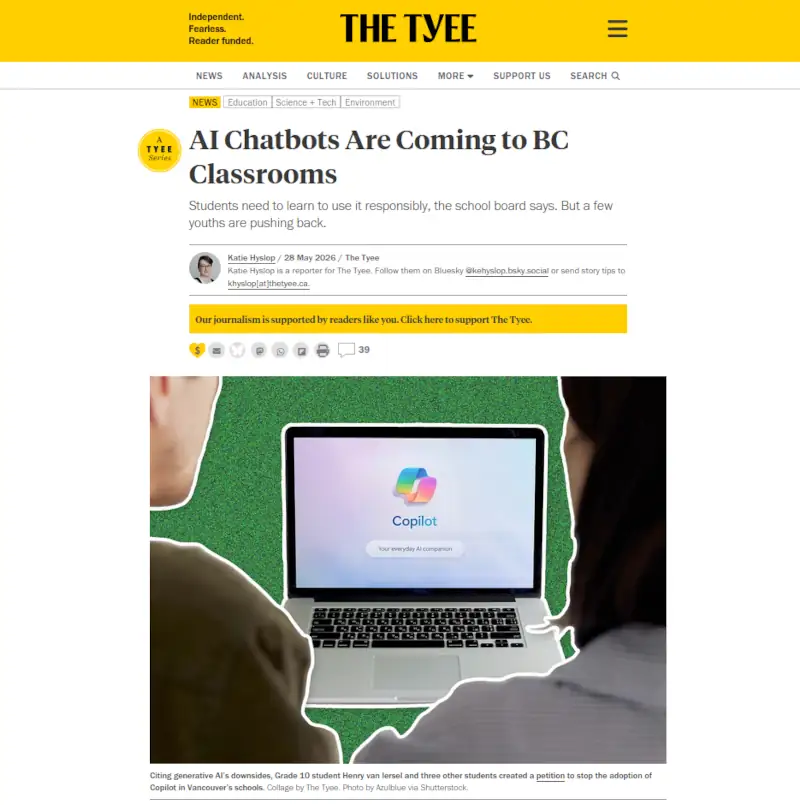
"AI Chatbots are Coming to BC Classrooms" was published in The Tyee, covering Vancouver School Board's plan to put Copilot into classrooms.
We are excited to see more people looking at the VSB plans, however there are some things to add that the article misses.
Not just "a few youths" pushing back
The subhead of the article is "Students need to learn to use it responsibly, the school board says. But a few youths are pushing back."
From this subhead and the general tone of the article, one might think that the plans are generally unopposed. This is inaccurate. AI is incredibly unpopular with students, parents and teachers.
At our recent pop-up event at Riley Park Farmers’ Market, we spoke with many students and teachers who were frustrated with AI. The article only interviews a single teacher, and they speak positively about AI. In our experience the majority of teachers do not want AI in classrooms.
This unpopularity is not just limited to local schools. In the US, AI is less popular than ICE. Students have been booing mentions of AI in graduation speeches.

Hundreds of protesters marched against proposed AI data centres in Vancouver. Image: @no.ai.vancouver
Also unmentioned in the article is the hundreds-strong protest on May 23 against proposed AI data centres. Most of the participants were young adults. The associated petition has over 8500 signatures so far. (Update: As of June 2026, it has reached 10,000 signatures)
Our own petition for a two-year pause on AI in schools has 650 signatures at the time of writing this. (Update: As of June 2026, it has reached 750 signatures) No mention of how Copilot will be used
The article does not cover that Vancouver School Board have not made it clear how Copilot would be used in classrooms. In a recent consultation meeting, parents raised many questions and concerns:
- Will students be able to use Copilot to write for them?
- Will it give feedback on their writing?
- How will students who use Copilot be evaluated against those who choose not to use it?
- Will its use be required?
- Will it solve problems for them?
- What happens when it gives incorrect information?
None of these questions have been answered by Vancouver School Board.
Cognitive offloading still unaddressed
Cognitive offloading is the effect of becoming less skilled, less knowledgeable, more "stupid", the more someone uses AI.
The school board's approach to generative AI is exemplified by da Silva's response to concerns about cognitive offloading. From the Tyee article:
"A lot of the worries about cognitive offloading, academic integrity, are a little bit more heightened," da Silva said. "But there's been strategies in the past to address this, and I think there'll have to be strategies to address this moving forward." Strategies such as talking to a student suspected of using AI to cheat, about the difference between the quality of that work and the skills and learning they have demonstrated in class up to that point. A student may be required to redo an assignment under a teacher's direct supervision.
The strategies mentioned do not address cognitive offloading at all. They are things that are done after the a student is found to "cheat" (something that lacks definition when using AI). Cognitive offloading happens simply by using AI.
The only strategy to avoid cognitive offloading is to not use AI.
Privacy
When dealing with data and students, Canadian law requires that all information be stored on servers within Canada. Microsoft are quick to point out that they comply with this law.
When asked about this, da Silva's replies:
Now who has access to it? I'm assuming that they're a corporation that doesn't let governments have access to it.
Mr da Silva's assumption is incorrect. Microsoft does let the US government access it.
Microsoft is required by the US CLOUD act to provide the United States government access to data stored on any Microsoft-owned server, regardless of what country the server is located.
We are hoping that this is the first article of many from media outlets, and that they will cover the broader antipathy towards AI in future articles.